Welcome to WordPress. This is your first post. Edit or delete it, then start writing!
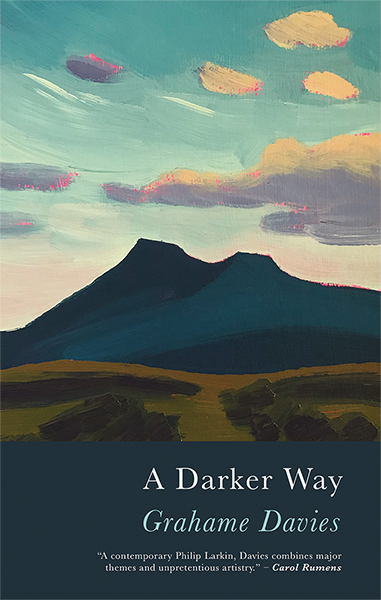
A Darker Way (Seren 2024)
“And, yes, they did those murals. You can tell?
No, not to everybody’s taste, but then,
neither was flaking whitewash, come to that.”
The voice in “Traveller” is surely that of a schoolteacher, but behind it I hear two Roberts: the ventriloquism of Browning and the seemingly ambling narratives, with pinpoint phrasing, of Frost. The latter also feels like the presiding genius in “Happy Larry”:
one of those characters, born middle aged,
that never stray five miles from where they’re born,
and in “Colleagues” – “The irreplaceable is soon replaced”.
Quite a few of the poems in this collection were commissions, some for songs (indeed the collection’s subtitle is “Poems and Songs”), which may partly explain the prevalence of regular metre and rhyme. It opens, however, with two poems about losing the impulse to write poems, seemingly because of a more untroubled life – “peace makes no poems” (“Scar”). The second of these, “Farewell to poetry”, would in my view be outstanding were it not for that title. It is really about the waning of desire, any desire, and the image he coins for it, of planes coming in to land, is perfect:
They used to stack up,
waiting in the sky
a long perspective of receding lights
out of the blackness,
coming in to land.
Stare at the dark for long enough,
you’d find
a star detach itself and float to earth.
And always more to come.
But that was then
Tying it to one kind of desire, the urge to write, with that title not only looks unnecessarily histrionic but detracts from the universality of the powerful ending:
Without knowing why,
I find this better:
silence after sound,
and solitude after society,
simply to walk out on the empty field,
feeling the wind across the open land,
expecting nothing from the empty sky.
Davies uses both rhyme and metre most skilfully, but there’s no denying that to some eyes and ears, they may give poetry a formal feel in more than one sense, and some readers react against that. Personally I rather like the classical vibe of epigrams like “A Marriage” – the title is from an R S Thomas poem on the death of his wife, and this clearly alludes to it:
For thirty years she loved him, or she tried,
but what she gave him, without price or pride,
was just a hazel staff cut from a hedge
that at the journey’s end is set aside.
And being myself a fan of Frost, I find the echo of his wry elegance ideally suited to the description of a sort of informal poetry event (“Centenary Square, Birmingham”)
It seemed, I thought, a special ring of Hell,
reserved, perhaps, for those who’d used their wit
to hurt, not heal, and sentenced for all time,
to bawl banalities through broken mics
with no-one there to hear, no audience,
except unsympathetic passers-by
to witness that they had no audience.
Now and again, I think he could trust the reader more. I didn’t need the photos that accompany some poems, and there are a couple of poem endings that seem too keen to tidy things up and press home a point already made, particularly “Speedway Eddie”, where to my mind the ending
I’m not so sure. From what I’ve heard
he never was a racer, just a fan.
Maybe we need to think that tragedy
must be the only way to break a man
could do very well without the last two lines. The poems about loss of faith, a recurring theme in this collection, don’t suffer from this; their uncertainty seems to have defied tidying up and gives them a fruitful ambiguity.
Another recurring theme is the poet’s Welsh identity, and indeed some poems here were originally written in Welsh and are the poet’s own translations, he being one of those enviable souls who are truly bilingual. But the two poems “A Welsh Prayer” and “A Welsh Blessing” are, surely by design, anything but intrinsically Welsh; they could refer to absolutely any country and the message of both is “be ready /to answer for this corner of the earth”. Davies is not an overtly “ecological” poet, but behind most of what he writes is a sense of the spirit of his surroundings, an urge to find “a better way to share this land, this light”.
Sheenagh Pugh
Reading A Darker Way by Grahame Davies is like gazing at a riot of flowers in a garden, a treasure trove of colourful discoveries, an archway into the magical world of the short form.
The poems reveal themselves in the simplicity of a child kicking and smiling in their sleep.
As the pages turn, you are transported through portals into different worlds from those of the Traveller. “Yes, we were nervous when they first came, at first, I won’t deny it.’’
And we move to Happy Larry’s Funeral, whom everyone knew, but no one dared to ask his name.
Siblings
We gather with the thin line of mourners to say farewell, and may the winds guide Larry. “So sad, she says. We were the only mourners that he had. She’s English. New to here, but not, I guess, to sorrow, which makes siblings of us all.’’
When a tree falls in the forest, does it indeed make a sound? But sorrow, Grahame Davies says, makes siblings of us all. It does not matter who you are or whence you hail from.
We all have those solitary moments and burdens, carrying them on our shoulders like crosses and lumbering around. Tears cascaded down my face as I read A Darker Way.
The voice is so intense that the reader suddenly grieves for Happy Larry and contemplates their mortality. Who would attend my funeral? Will I die alone and allow the elements of biology to take effect? Like a weaver bird plaiting a nest, the lines in this poem are like tiny twigs and feathers floating in the wind.
The grave and the coffin become “a place for Harry to be happy in.’’ A sobering mode when we leave the familiar landscape, places we call home, and return after many years, what has changed? Have we changed?
However, the author tells us that Larry is like many who never stray too far from their birthplace.
I got carried away by the wave after wave, bashing me back and forth in this collection of poems.
Beginning
Let me take you to the beginning with the last lines of the second poem, “Farewell to Poetry,’’ on page eight. “I find this better: silence after sound, and solitude after society, simply to walk out on the empty field, feeling the wind across the open land, expecting nothing from the empty sky.’’
A piece of advice from a sage to writers. Sometimes, it suffices to take time out, to stare at the blank page, and enjoy the silence. Listen to croaking frogs, trickling rivers, waterfalls streaming to the sound of the djembe drum, birds and crickets chirping, owls hooting.
Let nature speak, and you listen. This, for me, is not a farewell to poetry but a clear case of au revoir. Soak in a bathtub of mango leaves and lemongrass to recharge yourself. It is always good to take time out.
In the poem “Familiar’’ on page twenty, we enjoy reciprocated love and rekindling, and though I have known her for forty years, I will walk behind and follow her for another forty. “A county athlete, I ran after her. Heads turned. She didn’t care, cornering the terrain like a hare.’’
We then leap forward to the poem “Escape.’’ Familiar and Escape, with their themes of longing and the road not taken, reminded me of Robert Frost’s “The Road Not Taken’’ and William Butler Yeats’s “The Lake Isle of Innisfree’’ the writer dreams of just going, much like the themes of these classic poems.
“No one to miss me. No one to ask why. That would be freedom. Never to be known, and so, never forgotten, never called.’’
Compelling
A Darker Way is a compelling read for lovers of the short form, a collection of sixty-six poems that take you on an emotional journey. Divided into five sections, each poem is a unique experience, from the scars we carry to the visitors who leave an indelible mark, from the secrets we keep to the collective grief of a mining disaster and a pandemic.
As you delve into this collection, you will be on an emotional rollercoaster, experiencing solace, solitude, contemplations, love, and grief; each poem will carry you through various feelings.
Since Grahame Davies’ last poetry collection was in 2012, A Darker Way has been hibernating for twelve years. And I will say this: it has been worth the wait. Extra Guinea fowl feathers on your cap, Grahame Davies.
Eric Ngalle Charles, Nation Cymru
Author, poet, editor, librettist and literary critic Grahame Davies was brought up in the former coal-mining village of Coedpoeth, near Wrexham, in north-east Wales. His former career as a journalist and producer earned him a number of Welsh and industry awards. In 1999 his study of Wales and the anti-modern movement, the product of his doctoral research, was hailed as a landmark achievement in the field of literary criticism and he has been the recipient of many awards for his contributions to poetry. In 2023 he was made a Commander of the Victorian Order (CVO).
A Darker Way brings together a collection of poems and songs which explore the human psyche. The spiritual realm is never far from his work but Davies is not a poet who sees things in simplistic terms: belief and unbelief are held in equal measure. These questioning poems impress us with their honesty. In ‘Seeking’ we are invited to listen to “the sea’s insistent catechism.” At the end of the day, Davies tells us, “if there are no answers, / you know, at least, /you have not hidden from the questions.”
The suite of poems on Aberfan, which lies at the core of this collection, is both moving and powerful. In ‘Mining Disaster Memorial’ Davies turns the tables so that the dead address the living: “We do not ask you to remember us: / you have your lives to live as we had ours, / and ours we spent on life not memory.” His experience as a young newspaper reporter for the Merthyr Express and his responsibility for the paper’s coverage of the 20th anniversary of the disaster and, later, his involvement in the 50th anniversary commemorations inform the background to ‘Journalist’, where he speaks for all journalists who are tasked with reporting on tragic events: “You are not there to weep./ You are there because they are weeping. / And the world must know.” The poems are accompanied by a series of pictures reproduced with the permission of IC ‘Chuck’ Rapoport, who was one of the first photographers on the scene in the aftermath of the tragedy.
A suite of poems on Covid is equally powerful in its exploration of the pandemic. The poems were commissioned by the JAM on the Marsh festival, Romney Marsh, Kent, to accompany a performance of Fauré’s Requiem in St. Leonard’s Church, Hythe, to commemorate the dead. Several other poems such as ‘The Saviour in the Shawl,’ A Welsh Prayer’ and ‘A Welsh Blessing’ were written as a result of specific commissions and set to music by composers such as Paul Mealor, Eilir Owen Griffiths and Sarah Class. ‘Sacred Fire’ was performed by South African soprano Pretty Yende and the Coronation Orchestra at the coronation of King Charles in Westminster Abbey in 2023.
Among the other poems in this collection, ‘Goodbye to a home’ and its companion piece ‘A new home’ caught my attention. Here is the opening stanza of the former with its carefully crafted line breaks and conversational tone:
With no-one else we have spent
so much time, been more
ourselves, cared less
what people say. The world sees
what we want it to, but you
saw what we never showed the working day.
The opening stanza of its sequel is equally conversational:
I wonder if we could begin this way?
If we could set aside the words we use
habitually for all our habitations.
You know the ones I mean:
buying and selling, cash and equity,
possession, occupation, ownership.
Is all that really necessary? What must
you think of us who think that way?
Other poems range across a variety of subjects, making reference to, among other things, the speedway rider Eddie Castro, Belgian painter Fernand Toussaint, the crypt in St. Leonard’s Church, Hythe, the Welsh League of Hope and the motto of Goodenough College, London. Some of the shortest poems, such as ‘Connection,’ ‘Palimpsest’ and ‘A Marriage’ are beautifully succinct, the latter alluding to Mercury, perhaps, who carried a hazel staff which bestowed him with great wisdom and was later regarded as a symbol of happiness:
For thirty years she loved him, or she tried,
but what she gave him, without price or pride,
was just a hazel staff cut from a hedge
that at the journey’s end is set aside.
There is much to admire in this collection which, for all its sense of realism, its confrontation with tragedy and its reflections on the mystery of existence, reminds us that we are called to be salt and light.
Neal Leadbeater Write Out Loud